When people picture artificial grass, they picture the green surface. What actually determines whether that lawn lasts twenty years or fails in three is everything underneath it. If you are asking what goes under artificial grass, this guide walks through the full base and installation process we use on Pickering projects, from the first cut to the final brushing. Getting the base right is the whole job, which is why Artificial Grass Pickering spends most of its time below the turf, not on top of it.
What goes under artificial grass?
Under artificial grass sits a layered system: a compacted sub-base of crushed stone, a finer levelling course, a weed barrier, and infill worked into the turf on top. In order from the ground up, a proper Pickering install is native soil, geotextile fabric, an open-graded crushed stone base, a compacted screening or stone dust levelling layer, the turf, and then infill. Each layer has a job, and skipping any one of them shows up later as puddles, weeds, or a lawn that ripples.
Step 1: Removal and excavation
We start by stripping the existing lawn or surface and excavating to a set depth, usually 75 to 100 millimetres for a residential lawn and more for a heavy-use or pet area. On the clay soils common in Duffin Heights and Seaton we often dig a little deeper, because clay holds water and needs a thicker free-draining base above it. Excavating properly also keeps the finished turf flush with patios, walkways, and garden edges instead of sitting proud of them.
Step 2: Grading and drainage
With the area dug out, we shape the ground to fall away from the house and toward a suitable drainage point. Pickering's spring melt and summer downpours put drainage to the test, so this grade matters. On low-lying lots near Frenchman's Bay or along the West Shore we sometimes add a perforated drain line in the base to move water faster. The goal is simple: no water should ever sit under the turf.
Step 3: Weed barrier and sub-base
A geotextile fabric goes down to separate the native soil from the stone and to stop weeds pushing up through the seams. On top of that we build the sub-base from crushed stone, usually a 19 millimetre clear or a granular blend, laid in lifts and compacted with a plate compactor. This is the structural heart of the lawn. A well-compacted stone base is what stops the surface from rutting under foot traffic and from heaving during freeze-thaw cycles.
Step 4: Levelling layer
Over the compacted stone we add a finer layer of stone dust or screenings and compact it to a smooth, firm finish. This is the surface the turf actually rests on, and any lump or dip here will telegraph through the grass. We screed and check it carefully, because a flat, dense levelling course is the difference between a lawn that looks laid by hand and one that looks poured.
Step 5: Turf, seaming and fastening
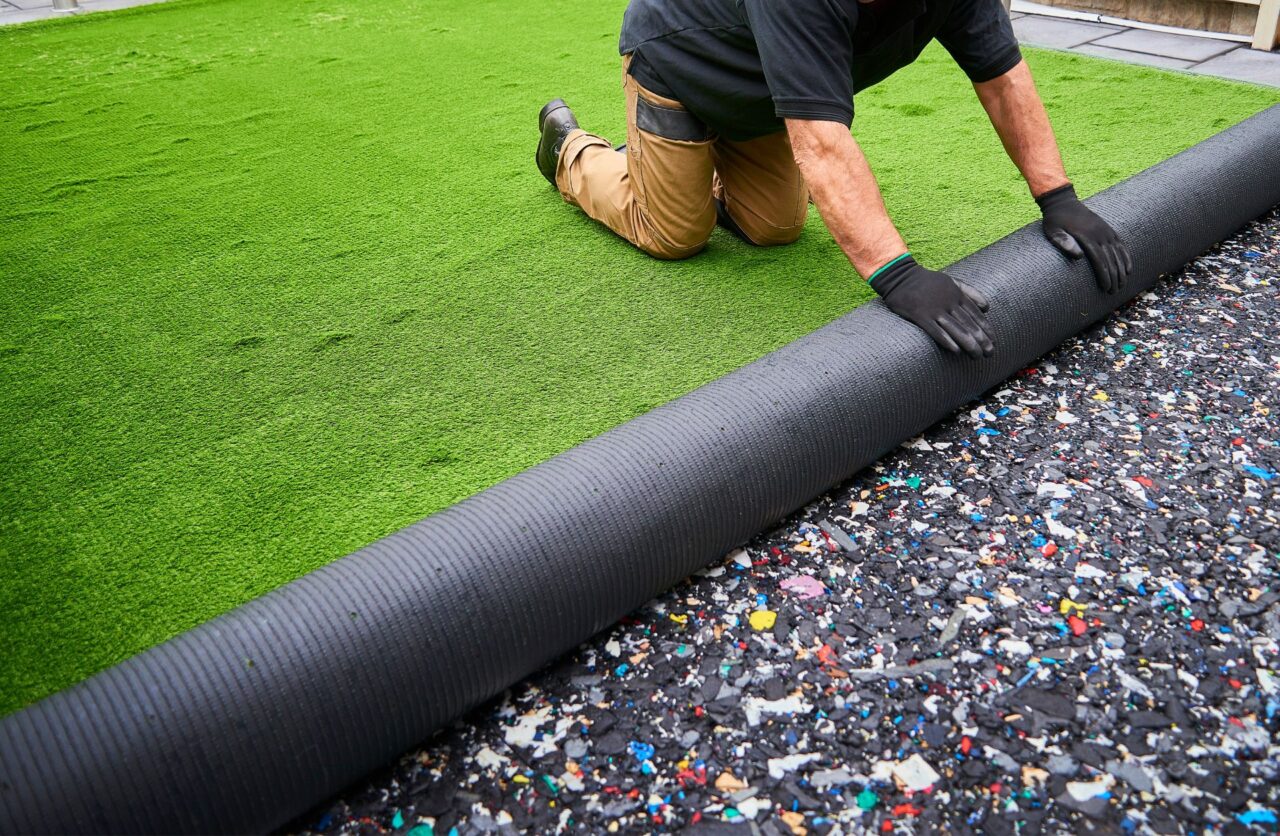
The turf is rolled out, left to relax so the backing settles, then cut to fit the space. Seams are glued and joined so they disappear, with the fibres all running the same direction for a uniform look. We fasten the perimeter with galvanized landscape spikes or a nailer board along hard edges. Careful cutting around trees, garden beds, and awkward corners is where an experienced Pickering crew earns its keep, particularly on the irregular lots in older Bay Ridges and Rosebank.
Step 6: Infill and finishing
Finally we brush in infill, typically a silica sand or a coated antimicrobial sand for pet areas. Infill weighs the turf down, keeps the blades standing upright, and protects the backing. We power-brush the fibres to lift them, sweep the surface clean, and walk the finished lawn with you. The same base process supports specialty surfaces too, from a backyard lawn to a level, true-rolling putting green.
Why the base matters more than the turf
You can install premium turf over a poor base and it will still fail. You can install mid-grade turf over an excellent base and it will look great for years. In a freeze-thaw climate like Pickering's, the base is what resists frost heave and keeps the surface flat and draining. When you compare quotes, the base spec tells you far more about the result than the turf brand does.
Frequently asked questions
Can artificial grass be installed over existing soil or grass?
Not directly. Laying turf on soil or over a living lawn traps moisture, invites weeds, and leads to an uneven, sinking surface. The soil has to be excavated and replaced with a compacted stone base first.
How deep is the base for artificial grass in Pickering?
Most residential lawns use a 75 to 100 millimetre compacted stone base. Clay-heavy sites in Seaton and Duffin Heights, pet areas, and high-traffic zones often call for a deeper base to drain and hold up through freeze-thaw.
Do I need a drain under artificial grass?
Not always. A properly graded open-stone base drains most yards on its own. Low-lying or clay lots may need an added perforated drain line, which we assess during the on-site visit.
Get your base done right in Pickering
The turf is the easy part. The base is where a lawn is won or lost, and it is worth doing properly the first time. Call (289) 277-0119 or visit our contact page for a free site assessment, and we will spec the base your yard actually needs.